
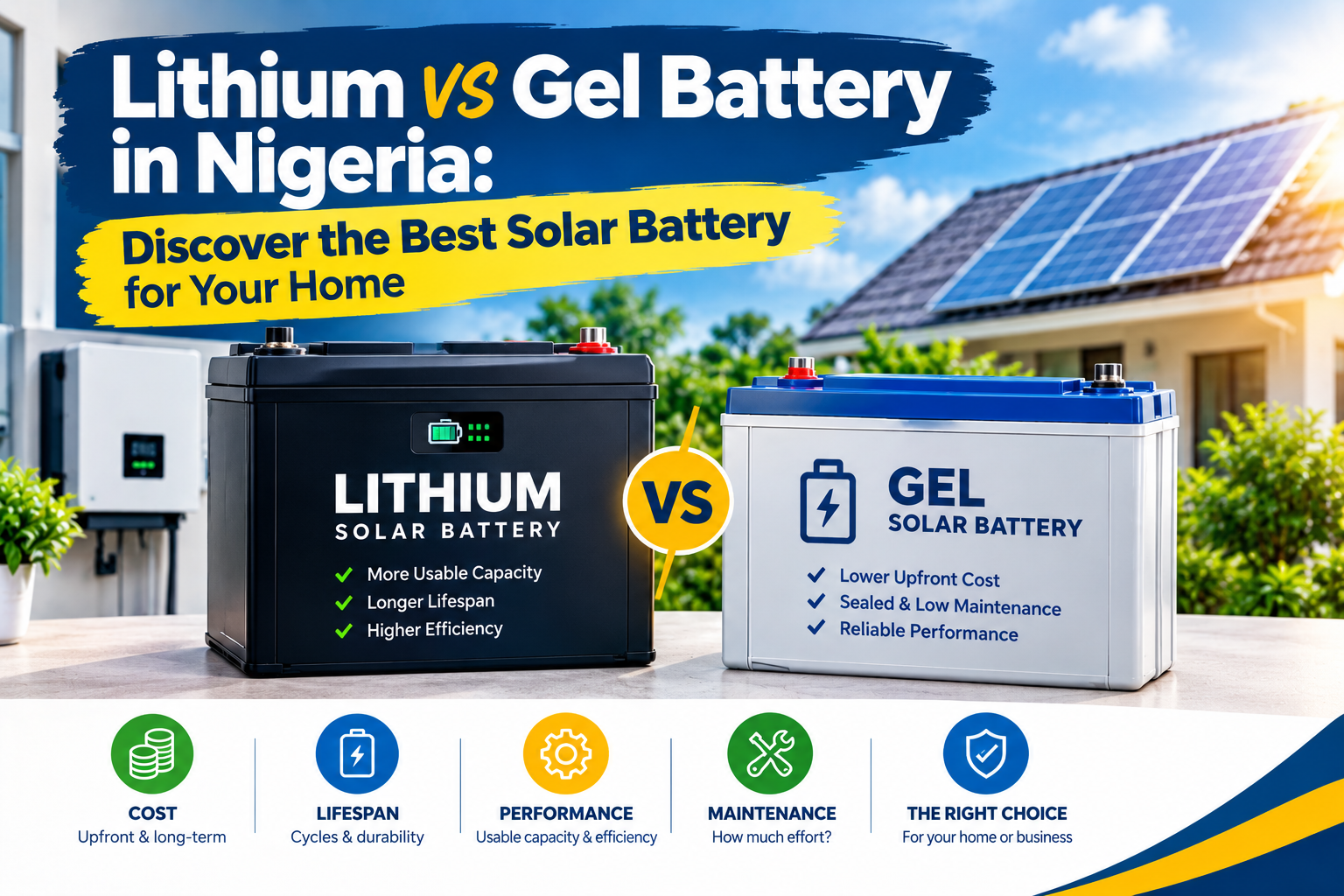
When comparing lithium vs gel battery in Nigeria, you need to look beyond the purchase price. You should also consider battery lifespan, usable capacity, charging efficiency, maintenance requirements, inverter compatibility, and the total cost of ownership. These factors matter whether you want reliable backup power for your home, shop, or office or commercial facility.
Lithium and gel batteries are both used in solar and inverter systems, but they work differently and offer different benefits. Understanding these differences will help you choose a battery that suits your electricity needs and budget.
Before you spend money on a solar battery, it is important to understand what separates lithium technology from gel battery technology. Although both store electricity for later use, their performance, charging requirements, and expected service life can differ considerably.
What is a lithium solar battery?
A lithium solar battery stores electricity using lithium-based electrochemical technology. Many modern solar storage systems use lithium iron phosphate, commonly called LiFePO₄ or LFP, because of its cycle life and thermal stability.
Lithium batteries are increasingly popular for residential and commercial solar installations because they can provide substantial usable energy in a relatively compact unit.
Here are some of their main advantages:
However, lithium batteries typically have a higher initial purchase price. You must also confirm that the battery is compatible with your inverter and that its battery management system is appropriate for the application. Temperature, charging settings, installation quality, and operating conditions can affect performance and lifespan.
What is a gel solar battery?
A gel battery is a type of sealed lead-acid battery. Its electrolyte is immobilised in a gel, allowing the battery to operate without the routine water topping-up required by some flooded lead-acid batteries.
Gel batteries have been used in inverter and backup power applications for years. They may appeal to buyers who want a lower initial purchase cost or whose energy requirements are relatively modest.
Their common advantages include:
Gel batteries also have limitations. They generally offer less usable capacity per rated amp-hour than lithium batteries when conservative discharge limits are followed. They may take longer to recharge and can lose service life if frequently discharged too deeply. You should also avoid treating all lead-acid batteries as interchangeable. Your inverter must be configured for the exact battery type.
Lithium vs gel battery: A side-by-side comparison
| Feature | Lithium battery (LiFePO₄) | Gel battery |
| Initial cost | Usually higher | Often lower |
| Usable capacity | Generally higher proportion of rated capacity | Usually lower proportion for long service life |
| Cycle life | Often longer | Usually shorter, depending on depth of discharge |
| Charging speed | Often faster, within specifications | Generally slower |
| Routine maintenance | Usually minimal | Usually minimal for sealed models |
| Weight and size | Often lighter and more compact | Often heavier for comparable usable energy |
| Charging requirements | Requires compatible lithium settings and protection | Requires gel-compatible charging settings |
| Best fit | Frequent cycling and longer-term storage needs | Budget-conscious or lighter-duty backup needs |
The table gives general tendencies, not guarantees. Actual performance depends on the battery model, usable capacity, operating temperature, depth of discharge, charging practices, and warranty terms.
Which battery lasts longer?
Lithium batteries, particularly quality LiFePO₄ models, often provide more charge-discharge cycles than gel batteries. However, the actual lifespan depends on how frequently you use the battery, how deeply you discharge it, and whether you operate it within its rated limits.
For example, a battery used every day to support a home through long power outages may experience substantially more cycling than a battery used only occasionally.
A gel battery that is consistently protected from deep discharge may last longer than one that is repeatedly drained beyond its recommended limits. Likewise, a lithium battery can deteriorate prematurely if it is exposed to unsuitable temperatures or incorrect charging settings.
When comparing lithium vs gel battery in Nigeria, ask the seller for the manufacturer’s cycle-life data and the conditions under which those figures were measured. A cycle-life claim is more useful when you know the assumed depth of discharge and the capacity remaining at the end of the test.
Which battery is more cost-effective?
The cheapest battery at the point of purchase is not always the cheapest option over several years.
Suppose a lithium battery costs more initially but offers greater usable energy and lasts through more charge cycles. It may provide better long-term value if you use your solar system frequently. A gel battery may make more financial sense if you have a limited budget, need modest backup, or expect to use the system less often.
To compare costs fairly, consider the purchase price, usable capacity, expected lifespan, efficiency, warranty, maintenance, and likely replacement costs.
You should also consider the cost of electricity interruptions. If your business relies on refrigerators, computers, internet equipment, or payment terminals, reliable backup power may help reduce disruption. Your actual financial benefit will depend on your loads and usage patterns.
Now that you understand the differences, how do you select the right battery for your property? The best choice depends on your daily energy consumption, budget, inverter, available charging power, and expectations for backup time.
Use this checklist before you buy.
1. Calculate your actual power requirements
Start by identifying the appliances you need to operate during a power outage. Include their power ratings and the number of hours you expect to use them.
Your installer should use this information to estimate your daily energy consumption and recommend an appropriate battery capacity.
Avoid selecting a battery solely because a seller describes it as suitable for a particular inverter size.
The inverter’s rating tells you about its power capability; it does not tell you how much energy the battery can store.
2. Understand battery capacity and usable energy
Battery capacity is commonly expressed in kilowatt-hours (kWh) or amp-hours (Ah). These measurements are not interchangeable without considering voltage.
For instance, a nominal 12.8-volt, 100Ah battery stores approximately 1.28kWh of nominal energy. The amount you can actually use will be lower and depends on the battery’s recommended discharge limit and system losses.
When comparing lithium vs gel battery in Nigeria, check both the rated capacity and the recommended usable capacity. Two batteries advertised with the same amp-hour rating may not deliver the same practical amount of energy over their service lives.
Ask your installer to explain how much energy will be available to your appliances and how long the battery is expected to last under your estimated load.
3. Check your inverter’s compatibility
Your inverter must support the battery technology you intend to use.
Lithium batteries may require communication between the battery management system and the inverter. Depending on the equipment, this can involve a supported communication protocol such as CAN or RS485, or a compatible configuration that does not use direct communications.
Gel batteries require suitable charging voltage and settings for their chemistry. Incorrect charging can shorten battery life.
Before purchasing, confirm the inverter model, battery voltage, supported battery types, charging current, and any communication requirements. Ask the installer to configure and test the system according to the manufacturers’ instructions. Check our previous article on Inverter sizing https://imprintscoenergy.com/can-a-solar-inverter-be-too-big-what-first-time-users-must-know/
4. Consider climate and installation conditions
High temperatures can affect battery performance and accelerate ageing. This makes the location of your battery important.
Install your battery in a dry, secure, appropriately ventilated area that meets the manufacturer’s temperature and clearance requirements. Avoid direct sunlight, excessive heat, water exposure, and poorly managed electrical connections.
Lithium batteries need suitable protection and must be installed according to their specifications. Gel batteries also need appropriate charging, protection, and installation conditions.
Do not assume either type can be placed anywhere simply because it is used for solar backup.
5. Compare warranties and manufacturer support
A battery warranty can tell you what the manufacturer is prepared to cover, but you need to read the terms carefully.
Check the warranty period, cycle or energy-throughput limits, exclusions, and the process for making a claim. Ask whether replacement units or authorised service support are available locally. A long warranty is less useful if you cannot obtain support when a problem occurs.
You should also request the product datasheet and proof of purchase, and keep these documents after installation.
6. Work with a qualified solar installer
A battery is only one part of your solar installation. The panels, inverter, wiring, protective devices, and charging configuration must work together safely.
Before paying, ask the installer to explain the system design and provide a written quotation. Confirm who will carry out the installation, what testing will be completed, and what after-sales support is available.
If you are unsure which option suits your home or business, contact Imprints Corporations Energy. Share your appliance list and expected backup hours so the team can assess your requirements.
When comparing lithium vs gel battery in Nigeria, focus on usable capacity, charging compatibility, lifespan, warranty, installation conditions, and total cost—not just the advertised price.
The right battery should match your actual energy requirements and work safely with the rest of your solar system. If you need help planning a solar solution for your home or business, visit Imprints Corporations Energy to enquire about available services and request guidance for your project.